
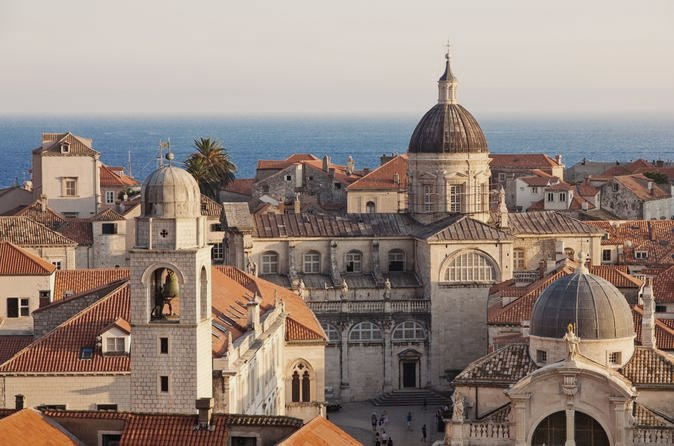
Dubrovnik is included on almost all of our Croatia cruises and Croatia tours — and for good reason. Few places in Europe pack so much character into such a compact space. The Old Town is entirely walkable, the city walls are among the best-preserved in the world, and the story behind it all goes back more than 1,300 years.
If you only want the short version: Dubrovnik is the walled coastal city at the southern end of Croatia’s Dalmatian coast, founded in the 7th century, known historically as Ragusa, and listed by UNESCO as a World Heritage site since 1979. A typical visit involves walking the city walls, exploring the Old Town along the Stradun, and ideally getting up to Mount Srđ for the view. Most of our one-way cruises either start or finish here.
Visiting Dubrovnik on a Small Ship Cruise
You may have read about Dubrovnik’s crowd problem — and it’s real, but it mostly affects visitors arriving on large ocean cruise ships, some carrying several thousand passengers at a time. When those ships are in port, the Pile Gate and Stradun can become genuinely busy during the middle of the day.
Our cruises are a different thing entirely. We sell small ship itineraries carrying around 40 passengers — vessels that feel more like a private charter than a floating resort. And the way our itineraries are structured means you’re in Dubrovnik at the right time, not the wrong one.
If your cruise finishes in Dubrovnik (as most of our one-way itineraries do), the ship arrives in the afternoon. You’ll have a guided walking tour of the Old Town in the late afternoon, then the evening is yours — dinner in the city, a walk along the walls at dusk, or a drink on the waterfront before heading back to the ship. The Old Town in the late afternoon and evening is genuinely quieter and more pleasant than it is at noon.
If your cruise starts in Dubrovnik, you’ll have a guided morning tour on the Sunday before the ship departs — again, well outside the window when the big ship crowds are at their peak.
Either way, you get Dubrovnik at its best.
What You’ll See on the Walking Tour
The guided walking tour covers the Old Town — the Stradun, the main squares, and the key landmarks inside the walls. It runs at an easy pace and gives you the historical context for everything you’re looking at. The walls themselves are not included on the cruise tour: they’re an optional extra you do on your own time, with a separate ticket.
The Stradun — the broad limestone promenade running the full length of the Old Town — connects the Pile Gate on the west to the Ploce Gate on the east, passing the Orlando Column, the Clock Tower, and Sponza Palace along the way. Sponza is one of the few buildings inside the walls to survive the 1667 earthquake intact: a 16th-century merchant customs house that now houses the city archive.
The Rector’s Palace sits just south of the Stradun near the Old Port. This was the seat of Ragusa’s chief magistrate — a position that rotated every month so no one person could accumulate too much power, which tells you a lot about how the republic ran itself. The building is now a museum.
At the western end of the Stradun, the Franciscan Monastery houses a pharmacy that has been operating continuously since 1317. The monastery cloister is quiet and worth a few minutes away from the busy Stradun.
Walking the City Walls
For most visitors the walls are the highlight of a Dubrovnik visit, but they’re done independently — not as part of the cruise walking tour. A full circuit is roughly 2km, with steps and inclines along the way. At a relaxed pace, stopping for photos and taking breaks in the heat, most people take around half a day. They’re not a cruise-day activity. Plan to do the walls on a day either before or after your cruise.
The views over the rooftops and out to the Adriatic are unlike anything else in Croatia. Look closely at the tiles and you’ll spot slight colour variations across the rooftops — careful restoration work from the 1990s. Most visitors don’t notice unless they know to look. Tickets are bought at the wall entrances.
Day Trips From Dubrovnik
The cable car to Mount Srđ is the easiest extra you can fit in. The lower station is just outside the Pile Gate, the ride takes a few minutes, and the view from the top — looking down over the whole city, the Old Port, and the islands beyond — is one of the better perspectives on Dubrovnik you’ll find. The restaurant at the summit is open year-round and is a popular lunch spot.
For travellers adding extra days to either end of their cruise, three day trips come up most often:
The Bay of Kotor (Montenegro) is the most popular full-day excursion from Dubrovnik. About a two-hour drive south along the coast, the bay is one of the most striking pieces of geography in the Adriatic — fjord-like inlets ringed by mountains, with the medieval walled towns of Kotor and Perast right on the water. Usually done as an organised day tour with a guide and driver.
Mostar (Bosnia & Herzegovina) is a longer day — about three hours each way — but consistently one of the most memorable. The Stari Most (Old Bridge) arching over the emerald Neretva River is the postcard moment, the Old Town has an Ottoman-era character that feels completely different to anywhere in Croatia, and the local food is excellent.
Cavtat is the easy option, about 20km south of Dubrovnik and close to the airport. A charming small coastal town with a quiet harbour and the Račić Mausoleum sculpted by Ivan Meštrović. It’s also the original Roman settlement (Epidaurum) that Dubrovnik’s founders came from in the 7th century.
If you’d like a guided land tour that combines your cruise with day trips like these, our tour options are a good place to start.
A Brief History
Dubrovnik traces its origins to the 7th century, when settlers from the Roman town of Epidaurum (today’s Cavtat) moved up the coast and established themselves on a small rocky island just offshore. Over time a Slavic community grew on the wooded mainland opposite, the two settlements merged, and the narrow channel between them was filled in. That filled channel became the Stradun.
Known for most of its independent history as Ragusa, the city grew into one of the most capable small states in medieval Europe. By the 15th and 16th centuries the Republic of Ragusa was operating a merchant fleet that rivalled Venice, running sophisticated diplomatic relationships with both the Ottoman Empire and the Christian powers of Europe, and maintaining an internal system of governance specifically designed to prevent autocracy. Rectors served for one month. No armed ships were permitted in the harbour. The republic stayed out of most of the major wars of the era by being more useful to everyone as a neutral trading partner than as an enemy.
In 1377, Ragusa established one of Europe’s first organised quarantine stations on a nearby island. The Lazarettos building on the harbour, dating from the early 17th century, is still standing today.
A major earthquake in 1667 prompted decades of rebuilding, which is what gave Dubrovnik much of its distinctive Baroque character — and why the architecture inside the walls reads as so unusually uniform for a place with a 1,300-year history.
Napoleon ended the republic in 1806. The city passed through French then Austrian control before becoming part of Yugoslavia after World War I. The name Dubrovnik — from the Croatian word for oak — had been in use among the Slavic population throughout, and eventually replaced Ragusa in official use. UNESCO World Heritage listing came in 1979, and Dubrovnik has been one of the most photographed cities in Europe ever since.
Game of Thrones and King’s Landing
Dubrovnik served as the principal filming location for King’s Landing in HBO’s Game of Thrones, and a number of the series’ most recognisable scenes were shot inside the walls and on Lokrum. If you’re a fan, the locations are easy to find on your own — the steps from the Shame walk are the Jesuit Stairs near the Cathedral, and Lokrum’s monastery houses a replica Iron Throne. If you’re not a fan, you’ll never know the difference.
Frequently Asked Questions
How much time will I have in Dubrovnik on the cruise?
On a cruise that finishes in Dubrovnik, you arrive in the afternoon and have the rest of that day plus the evening to explore — the guided walking tour covers the Old Town highlights and you have free time afterwards. On a cruise that starts in Dubrovnik, you embark Saturday afternoon, do the guided morning tour on Sunday, and depart Sunday afternoon.
Is there enough time to walk the city walls on cruise day?
No. The walls take around half a day at a relaxed pace, so they’re not realistic to fit into your cruise day alongside the guided tour and free time in the Old Town. If walking the walls matters to you, plan to do them on a separate day either before or after your cruise.
What should I wear for the walking tour?
Comfortable walking shoes are the main thing — the limestone streets are uneven in places and there are steps on the side lanes. In summer, a sun hat, sunglasses, and a bottle of water are well worth carrying. In spring and autumn, layers help.
Cruises and tours that include Dubrovnik
Most of our one-way itineraries start or finish in Dubrovnik. Browse our one-way Croatia cruises or see all departures.
Not sure what suits you? Get in touch or call us on +61 2 9212 1507 — we’re happy to talk through your options.